LED vs Halogen Savings Calculator
See how much you save each year by switching bulbs to LED, and how fast the change pays for itself, based on wattages, hours and your electricity price.
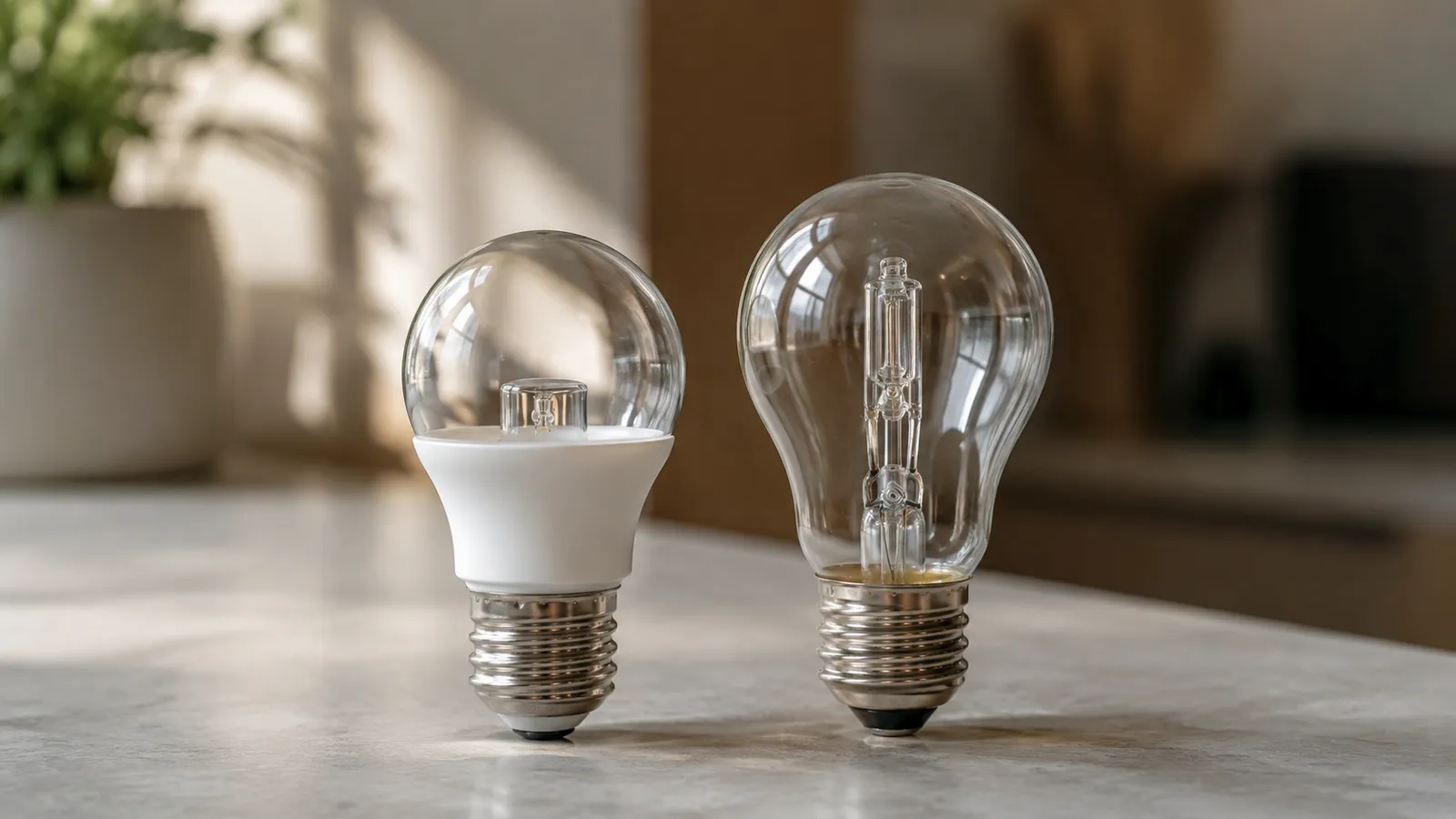
Swapping halogen bulbs for LEDs is one of the cheapest energy upgrades there is. Enter how many bulbs you would switch, their old and new wattages, daily hours and the price of an LED to see the yearly saving and how quickly it pays for itself.
LED vs halogen savings calculator
Saves about
/ year
- Pays back in
- Old bulbs / year
- LEDs / year
Payback counts electricity only — LEDs also last far longer.
Side by side
How the math works
The power saved is bulbs × (old watts − LED watts). Turn that into kWh a year (× hours × 365 ÷ 1,000) and multiply by your price for the yearly saving. Payback is the total LED cost divided by that yearly saving.
Worked example: 10 bulbs going from 50 W to 6 W save 440 W. Over 4 h/day that is 642 kWh a year — about $116 at $0.18/kWh. At $3 per LED ($30 total), they pay for themselves in roughly 3.1 months.
Assumptions and limits
This assumes the LED gives the same usable light as the bulb it replaces — check lumens, not just watts, when you buy. It counts electricity savings only; the real case for LEDs is even stronger because they last 10–25× longer, so you also buy far fewer bulbs. It does not include any disposal of working bulbs or dimmer compatibility quirks.
When this calculator helps most
Use this room by room rather than for the whole house at once — a hallway light used for 20 minutes a day pays back on a completely different timeline than a kitchen light on for six hours, so the same LED swap can be a no-brainer in one room and barely worth the trip to the shop in another.
Mistakes that throw off the estimate
The most common mistake is comparing wattage without checking lumens — an LED needs to produce the same usable brightness as the bulb it replaces, not just use less power, or you'll under-light the room and end up adding a second fixture. The second is ignoring bulbs that are barely used: a rarely-lit utility cupboard bulb might take years to pay back a replacement on electricity savings alone, even though the maths look identical to a heavily used one at the wattage level.
Beyond electricity: the lifetime difference
This calculator only prices the electricity saved, but bulb lifetime is where the case for LEDs gets even stronger. A typical halogen bulb lasts roughly 1,000–2,000 hours; a comparable LED is commonly rated for 15,000–25,000 hours or more — often 10 to 25 times longer. Over the same number of years, a frequently-used halogen fitting might need replacing a dozen times while the LED in the same socket needs none, which is real money and real hassle this calculator doesn't count at all. For fittings that are awkward or expensive to access — a stairwell, a high ceiling, anywhere a ladder is involved — that avoided-replacement value is often worth more than the electricity saving itself.
What it costs in practice
Yearly saving from swapping 50 W halogens for 6 W LEDs, at 4 hours a day, at $0.18/kWh.
| Bulbs | Halogen | LED | You save |
|---|---|---|---|
| 5 | $66 | $8 | $58 |
| 10 | $131 | $16 | $116 |
| 20 | $263 | $32 | $231 |
Your own price and habits change these — the calculator above uses your numbers.
Frequently asked questions
Do LEDs really use that much less power?
Yes. An LED giving the same light as a 50 W halogen draws about 5 to 7 W, roughly 85 to 90 percent less, because halogens waste most of their energy as heat.
How fast do LED bulbs pay for themselves?
Often within months for bulbs used several hours a day. The energy saved each year usually dwarfs the small upfront cost, and LEDs last far longer.
Is it worth replacing halogens that still work?
For frequently used lights, usually yes: the running-cost saving outweighs the price of a new LED quickly. For rarely used fittings the payback is slower.