How much does an induction hob cost to run?
Figures on this page are calculated from typical appliance wattages and the price per kWh you enter, not looked up from a bill. See how we calculate this.
What an induction hob costs to run: typical 3000 W, about $197 a year. Adjust the figures to your own usage and electricity price.
Your Induction hob running cost
Costs about
/ month
- Per day
- Per year
- Energy per day
Change the hours and price to match your case.
Wattage and running cost
| Low | 1400 W |
|---|---|
| Typical | 3000 W |
| High | 7400 W |
| Typical use | 1 h/day |
| Per hour of use | 3 kWh · $0.54 |
| Per day | 3 kWh · $0.54 |
| Per month | 91 kWh · $16 |
| Per year | 1,095 kWh · $197 |
Based on 1 h a day at $0.18/kWh, the US average. Change the hours and the price in the calculator above.
An induction hob is a high-power appliance, but it is also the most efficient way to cook on electricity. Instead of heating an element that then heats the pan, induction creates the heat directly in the pan itself using a magnetic field, so very little energy is wasted warming the air or the cooktop. A hob's total wattage looks alarming — a large four-zone hob can be rated at 7,000 watts or more — but that is the maximum if every zone runs flat out at once, which almost never happens in normal cooking.
In practice each zone draws power in bursts and you rarely use them all at full power, so real consumption is far below the nameplate figure. Because induction transfers heat so efficiently and boils water noticeably faster than gas or ceramic hobs, food reaches temperature sooner and the hob is on for less time. Enter a realistic average of how many zone-hours you cook per day at a typical power, along with your electricity price, to see what your own cooking costs.
One more advantage is control. Induction responds instantly to a change in the setting, like gas, so there is no waiting for an element to cool down. That responsiveness means less overshoot and less wasted heat, and combined with the fast boil times it is a large part of why induction usually uses less electricity than a ceramic hob to cook the same meal.
In round numbers, induction converts roughly 85-90% of the energy it draws into heat in the pan, a radiant or ceramic electric hob around 65-70%, and a gas burner around 40% once the heat lost around the pan is accounted for. That gap is why switching from ceramic to induction typically cuts hob electricity use by a quarter to a third for the same amount of cooking, even before counting the faster boil times.
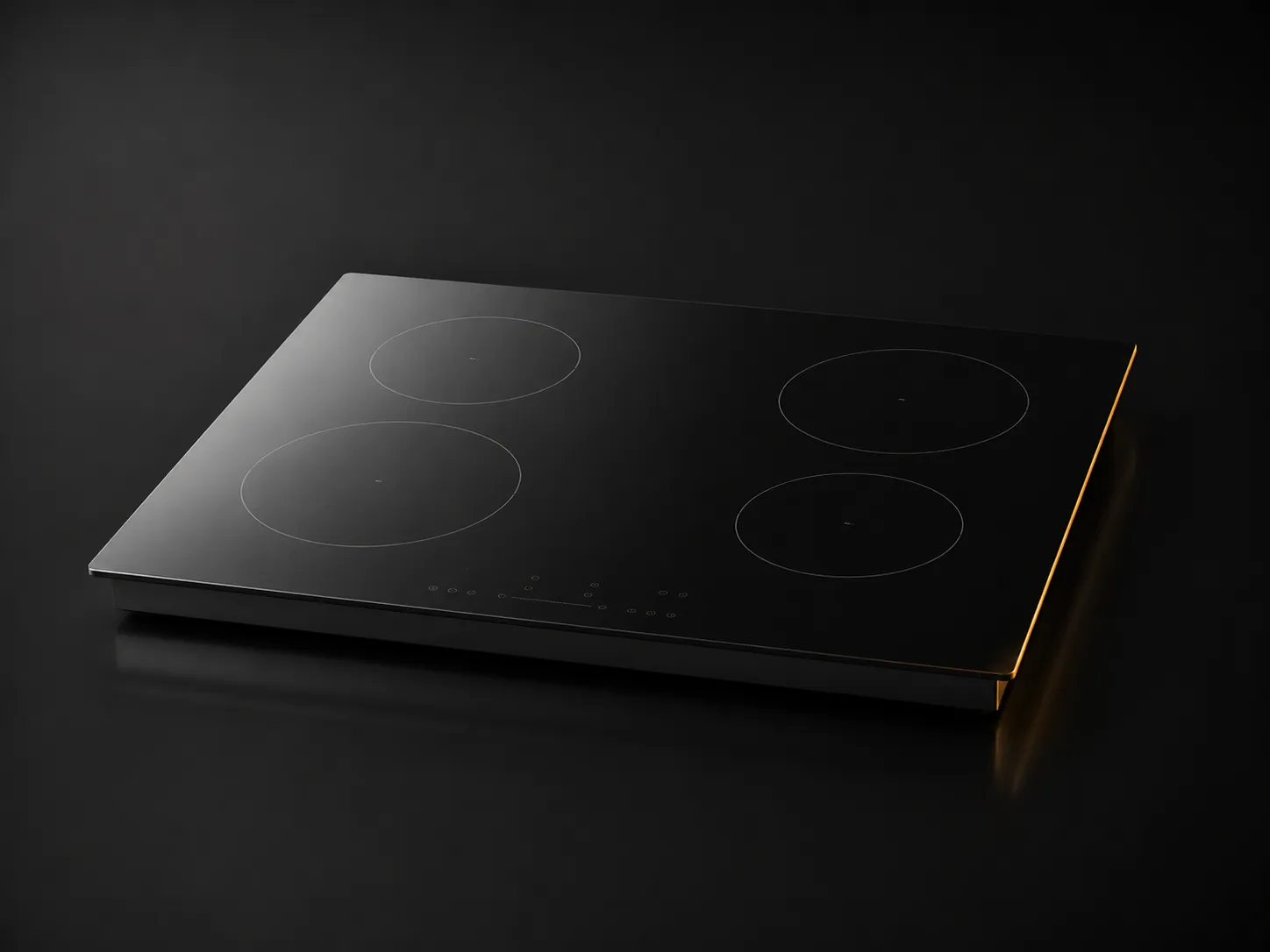
It is worth checking which hob you are actually calculating for, because two very different appliances hide under the same sheet of black glass. An induction hob heats the pan itself with a magnetic field; a ceramic — or radiant — hob heats a coil beneath the glass and lets that warm the pan. From above they look almost identical, but they behave differently: induction works only with magnetic cookware and stops drawing power the instant you lift the pan, while a radiant zone glows on for a while after you switch it off. Nameplate ratings are similar, commonly 5,500 to 7,400 W for a four-zone hob of either kind, so the difference shows up not on the label but in how long the zones are actually on. The quickest test: if a magnet sticks to the base of your pan and the hob refuses to heat with nothing on it, it is induction.
What an induction hob costs in other countries
The figures above assume $0.18/kWh, the US average. An induction hob does not change when it crosses a border — the price of the electricity it drinks does. Here is what its 1,095 kWh a year cost in the 14 countries with a page here, dearest first.
| Country | Per year | Per year (US$) |
|---|---|---|
| Ireland | 438 € | $504 |
| Germany | 427 € | $482 |
| United Kingdom | £350 | $471 |
| Belgium | 383 € | $438 |
| Austria | 361 € | $416 |
| Italy | 329 € | $372 |
| Spain | 296 € | $339 |
| Sweden | 3,274 kr | $339 |
| France | 285 € | $329 |
| Netherlands | 285 € | $329 |
| Australia | A$438 | $307 |
| Portugal | 263 € | $296 |
| United States | $197 | $197 |
| Canada | C$186 | $131 |
Each figure is in that country's own currency at its average all-taxes-included price; the dollar column is there so they can be set against each other. Ireland to Canada is a factor of 3.8 — same appliance, same hours, 3.8 times the bill. Follow a country for its real retailer tariffs and what makes up that price, or see the full electricity price comparison by country.
How to cut induction hob running costs
- Match the pan size to the zone — an oversized zone under a small pan wastes energy.
- Use a lid: water boils faster and stays hot with far less power.
- Turn zones down once food is simmering; induction responds instantly.
- Flat, magnetic-bottom pans transfer heat best — warped pans lose efficiency.
- Boil water in the kettle first if you only need a small amount.
Frequently asked questions
Does an induction hob really use 7,000 watts?
Only if every zone runs at maximum at the same time, which rarely happens. Normal cooking uses one or two zones at partial power, so real consumption is a fraction of the nameplate total.
Is induction cheaper to run than gas or ceramic?
For electricity efficiency, induction wins clearly over ceramic and heats faster than gas. Whether it is cheaper than gas depends on the gap between your electricity and gas prices per kWh.
Why does induction feel so much faster?
It puts heat straight into the pan instead of warming an element first, so almost all the energy reaches the food. Water boils noticeably faster, which also means the hob is on for less time.
Can I use this calculator for a ceramic hob?
Yes. Enter the ceramic hob's own rating, which sits in the same range as an induction one, and then be honest about the time: a radiant zone takes longer to bring a pan up to temperature, so the same meal keeps it switched on for longer. That extra on-time is where the efficiency gap above turns into kilowatt-hours. The consolation is the residual heat — switch a radiant zone off a few minutes early and let the glass finish the cooking.
Hob, cooktop, stovetop, ceramic — is this all the same appliance?
Mostly. It is a hob in British English and a cooktop or stovetop in American English, and all of them mean the flat cooking surface set into the worktop rather than the oven below it. "Ceramic" is the exception: it names a specific radiant hob, which is not the same as induction even though both are flat black glass. The figures on this page are for induction — the paragraph above explains how to tell them apart.