Heat Pump vs Gas Boiler Running Cost: Where the Break-Even Is
A heat pump beats a gas boiler above one number: the break-even COP. It runs from 1.2 in Sweden to 3.6 in Belgium — the same machine, opposite verdicts.
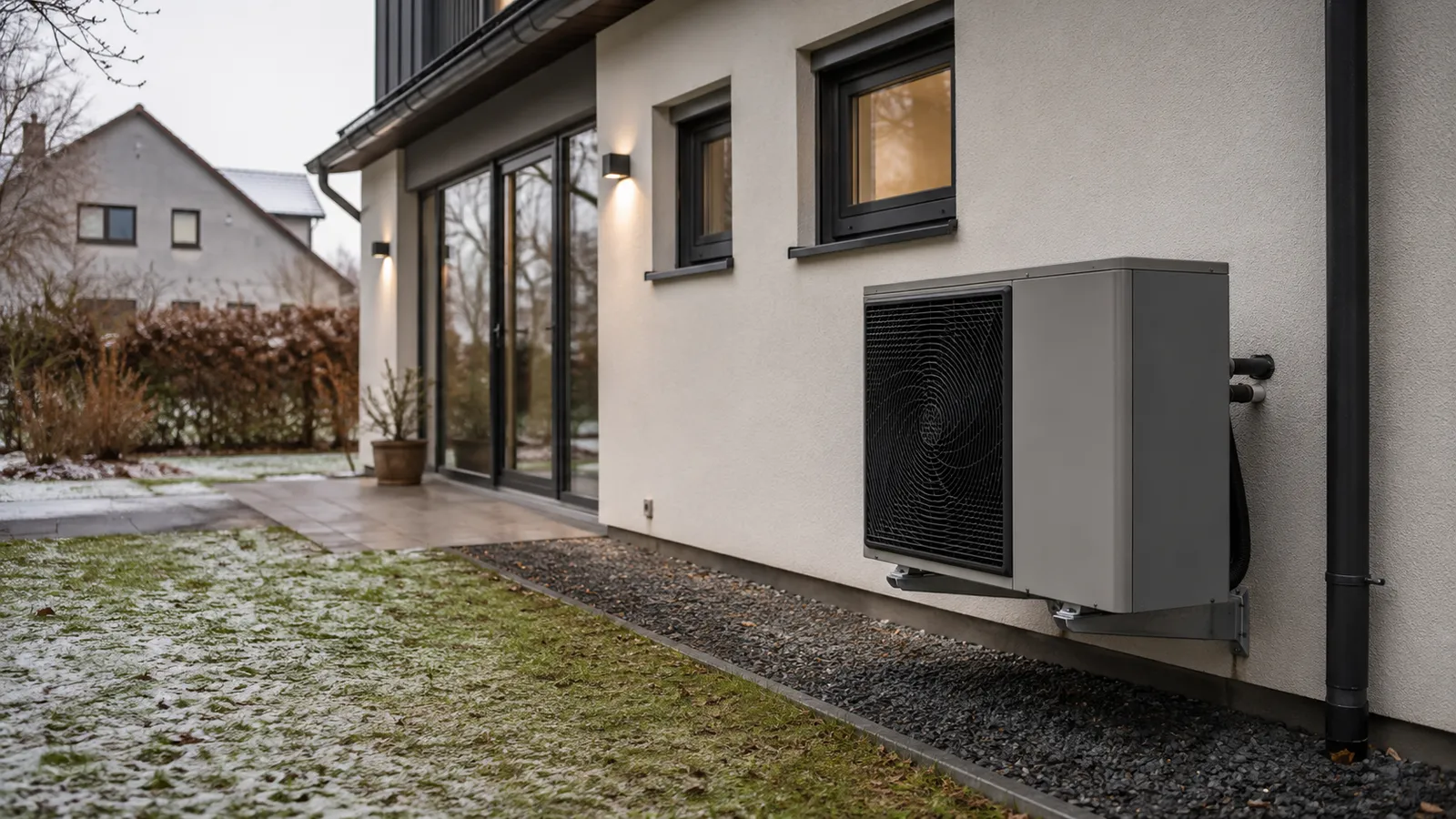
Whether a heat pump costs less to run than a gas boiler is barely a question about the machine. Both numbers you need are printed on your own bills: the price of a kWh of electricity and the price of a kWh of gas. Divide one by the other, adjust for the fact that a boiler wastes some of what it burns, and you get a single threshold — the break-even COP. Above it the heat pump is cheaper to run. Below it the boiler is.
Across the eleven countries where this site holds both prices, that threshold runs from 1.19 in Sweden to 3.58 in Belgium. That is not a small variation. A heat pump with a seasonal efficiency of 3.0 — an ordinary, well-installed air-source unit — is a comfortable win in seven of those countries, a marginal call in two, and more expensive to run than the boiler it replaced in the United States and Belgium.
So the useful version of this comparison is not "is a heat pump cheaper?" but "what efficiency do I need to hit where I live, and can my installation actually reach it?" The rest of this page is that number, country by country, and what moves it.
The one number that decides it
A gas boiler burns a kWh of gas and delivers slightly less than a kWh of heat, because some goes up the flue. A modern condensing boiler is around 92% efficient in real use, which is the figure this site uses everywhere — the heat pump comparison calculator, the fourteen country pages and this guide all take the same 0.92, so none of them can quietly disagree with the others.
A heat pump does not burn anything. It moves heat, and its Coefficient of Performance is how many kWh of heat it delivers per kWh of electricity it draws. COP 3.0 means three out for one in.
Put those side by side and the cost of delivering one kWh of heat into the room is:
- Gas boiler: gas price ÷ 0.92
- Heat pump: electricity price ÷ COP
Set them equal and the COP falls out on its own:
break-even COP = electricity price × 0.92 ÷ gas price
Everything else — the size of your house, how cold the winter is, how many hours the system runs — cancels out. Those things change how much you spend, but not which system spends less per unit of heat. That is why one number can carry the whole comparison, and why national averages are enough to answer it even though they are useless for predicting your actual bill.
The break-even COP where you live
These are the residential averages behind electricity prices by country, with gas on the same per-kWh basis, sorted by how easy the threshold is to clear.
| Country | Electricity /kWh | Gas /kWh | Electricity ÷ gas | Break-even COP |
|---|---|---|---|---|
| Sweden | 2.99 kr | 2.309 kr | 1.3× | 1.19 |
| Netherlands | €0.26 | €0.172 | 1.5× | 1.39 |
| Portugal | €0.24 | €0.141 | 1.7× | 1.57 |
| France | €0.26 | €0.144 | 1.8× | 1.66 |
| Italy | €0.30 | €0.148 | 2.0× | 1.86 |
| Austria | €0.33 | €0.122 | 2.7× | 2.49 |
| Spain | €0.27 | €0.096 | 2.8× | 2.59 |
| Ireland | €0.40 | €0.130 | 3.1× | 2.83 |
| Germany | €0.39 | €0.122 | 3.2× | 2.94 |
| United States | $0.18 | $0.049 | 3.7× | 3.38 |
| Belgium | €0.35 | €0.090 | 3.9× | 3.58 |
The advice you will read most often about this comparison is that electricity costs "three to four times" what gas does, so you need a COP above three or four to break even. On these figures that is true in four of the eleven countries and wrong in the other seven. In Sweden the ratio is 1.3×; in the Netherlands, Portugal, France and Italy it is under 2×. Repeating a US or Belgian ratio to a Dutch or Swedish reader gets the answer backwards.
The US gas figure deserves a note, because it is the one most easily mis-taken. It is $1.44 per therm, or $0.049 per kWh, and it is the residential average over the last complete November–March heating season. Per-unit gas prices in summer are mostly standing charge divided by almost no gas — the US average more than doubles between January and August — so quoting a July figure would make the boiler look roughly twice as expensive as it is when you actually need it.
The same machine, opposite verdicts
Take one heat pump and move it from country to country. Nothing about the hardware changes; only the threshold it has to clear does.
| Seasonal COP | Cheaper than gas in | Dearer than gas in |
|---|---|---|
| 2.0 (poor install, cold climate, old radiators) | 5 of 11 — SE, NL, PT, FR, IT | AT, ES, IE, DE, US, BE |
| 2.5 (typical retrofit onto existing radiators) | 6 of 11 — adds AT | ES, IE, DE, US, BE |
| 3.0 (well-sized, low flow temperature) | 9 of 11 — adds ES, IE, DE | US, BE |
| 3.5 (underfloor heating, mild winter) | 10 of 11 — adds US | BE |
The interesting row is the jump from 2.5 to 3.0. Half a point of seasonal efficiency flips three countries — Spain, Ireland and Germany — from losing to winning. In those three, the whole financial case rests on installation quality rather than on the choice of technology, which is exactly where it is most often lost: a heat pump bolted onto radiators sized for a 70 °C boiler will not reach 3.0, no matter what the brochure says.
Belgium is the one country in this table where no realistic air-source installation clears the bar. At a break-even of 3.58, a heat pump there is bought for its carbon, its cooling in summer, or its independence from a gas connection — not to cut the heating bill.
What a real seasonal COP looks like
The number on the box is not the number you will get. Manufacturers quote COP at a specified pair of temperatures, and the figure that matters over a winter is the seasonal one, averaged across every hour the system runs, including the coldest.
Three things pull it down:
- Outside temperature. An air-source heat pump extracts heat from the air, so the colder it is the harder it works. COP falls as the outdoor temperature falls, and it falls precisely when you are asking for the most heat.
- Flow temperature. The bigger the gap between the water you send to the radiators and the air outside, the lower the COP. This is why underfloor heating at 35 °C outperforms retrofitted radiators at 55 °C by a wide margin, and it is usually the largest single lever an installer controls.
- Backup resistance heat. Most systems have an electric element for the coldest hours. It runs at COP 1.0 — the same as a plug-in space heater. Every hour it runs drags the seasonal average down, and in a badly sized system it runs a lot.
The U.S. Department of Energy describes heat pumps as delivering the equivalent of 300–400% efficiency, and that is a fair description of a good unit under good conditions. Treat it as the top of the range and not as a planning assumption: for a retrofit onto existing radiators in a temperate climate, 2.5 to 3.0 is the honest band, and the table above shows how much rides on which end of it you land.
A worked winter day
Take a day needing 60 kWh of heat delivered into the house — a cold day in a mid-sized, reasonably insulated home. At United States prices, $0.18/kWh for electricity and $0.049/kWh for gas:
| How the heat is made | Efficiency | Energy bought | Cost for the day |
|---|---|---|---|
| Condensing gas boiler | 92% | 65.2 kWh of gas | $3.20 |
| Heat pump, seasonal COP 2.5 | 250% | 24.0 kWh of electricity | $4.32 |
| Heat pump, seasonal COP 3.38 | 338% | 17.8 kWh of electricity | $3.20 |
| Heat pump, seasonal COP 4.0 | 400% | 15.0 kWh of electricity | $2.70 |
| Running on resistance backup | 100% | 60.0 kWh of electricity | $10.80 |
The third row is the break-even from the table above, and it lands on the boiler's cost to the cent — which is what a break-even is. The last row is the one worth staring at: an hour on backup heat costs more than three hours of boiler, so a system that leans on its element through a cold snap can spend its whole winter's saving in a fortnight.
Note also that the COP 2.5 row costs 35% more than the boiler in the United States, and the same row is cheaper than the boiler in Sweden, the Netherlands, Portugal, France and Italy. Same appliance, same day, same 60 kWh.
What the break-even leaves out
The threshold answers one question cleanly and says nothing about several others.
- Standing charges. A house that keeps gas for cooking still pays the gas standing charge. A house that removes the gas connection entirely stops paying it, which is a real saving the per-kWh comparison cannot see, and in some markets it is worth more than the difference in unit rates.
- Capital cost and subsidies. The break-even is about running cost only. Installation is several thousand either way, grants vary enormously by country, and the payback period is a separate calculation on top of this one.
- Time-of-use tariffs. A break-even computed from a flat average understates a heat pump on an off-peak tariff, because a well-controlled system can move much of its load into cheap hours. Gas rarely offers the same lever.
- Cooling. Most heat pumps run in reverse in summer. If that replaces a separate air conditioner, the comparison stops being like for like.
- Carbon. The break-even is money. On emissions, a heat pump on a grid like Sweden's or France's is not close to a boiler, and the country pages carry the grid intensity figure for each.
Work out your own break-even
Take the two unit rates off your own bills, not the national average — regional and tariff variation is larger than several of the gaps in the table above. Then:
your electricity price × 0.92 ÷ your gas price = the COP you need to beat.
Compare it against a realistic seasonal figure for the installation you would actually get, not the headline COP: what flow temperature your emitters need, and how often the backup element is likely to run. The heat pump vs gas calculator does the arithmetic at any pair of prices, and each of the country pages carries its own break-even alongside the prices it comes from.
If the answer comes out close either way, the honest conclusion is that running cost is not the deciding factor for you, and the decision should be made on the things the break-even leaves out.
Frequently asked questions
Is a heat pump cheaper to run than a gas boiler?
It depends entirely on the ratio between your electricity and gas prices. The threshold is your electricity price × 0.92 ÷ your gas price, and across the countries on this site it runs from 1.19 in Sweden to 3.58 in Belgium. A seasonal COP of 3.0 beats gas in nine of eleven countries and loses in the United States and Belgium.
What COP do I need for a heat pump to pay off?
Exactly the break-even figure for your own prices — 1.66 in France, 2.59 in Spain, 3.38 in the United States. Compare it against a realistic seasonal COP, not the manufacturer's headline number: a retrofit onto existing radiators typically lands between 2.5 and 3.0.
Why does the same heat pump save money in one country and not another?
Because only the price ratio changes. Electricity costs 1.3× gas in Sweden and 3.9× in Belgium, so the efficiency a heat pump must reach to break even is three times higher in one than in the other. The hardware is identical; the threshold is not.
Does a heat pump still win on the coldest days?
Usually not. COP falls as the outside temperature falls, and if the backup resistance element runs it works at COP 1.0 — the same as a plug-in heater, and at United States prices more than three times the cost of the boiler for the same heat. The seasonal average is what decides the winter; the coldest week is where it is lost.