Space Heater Running Cost: Per Hour, Per Day and Per Winter
What a plug-in electric heater really costs per hour, per day and per season, with worked examples at real prices and cheaper ways to stay warm.
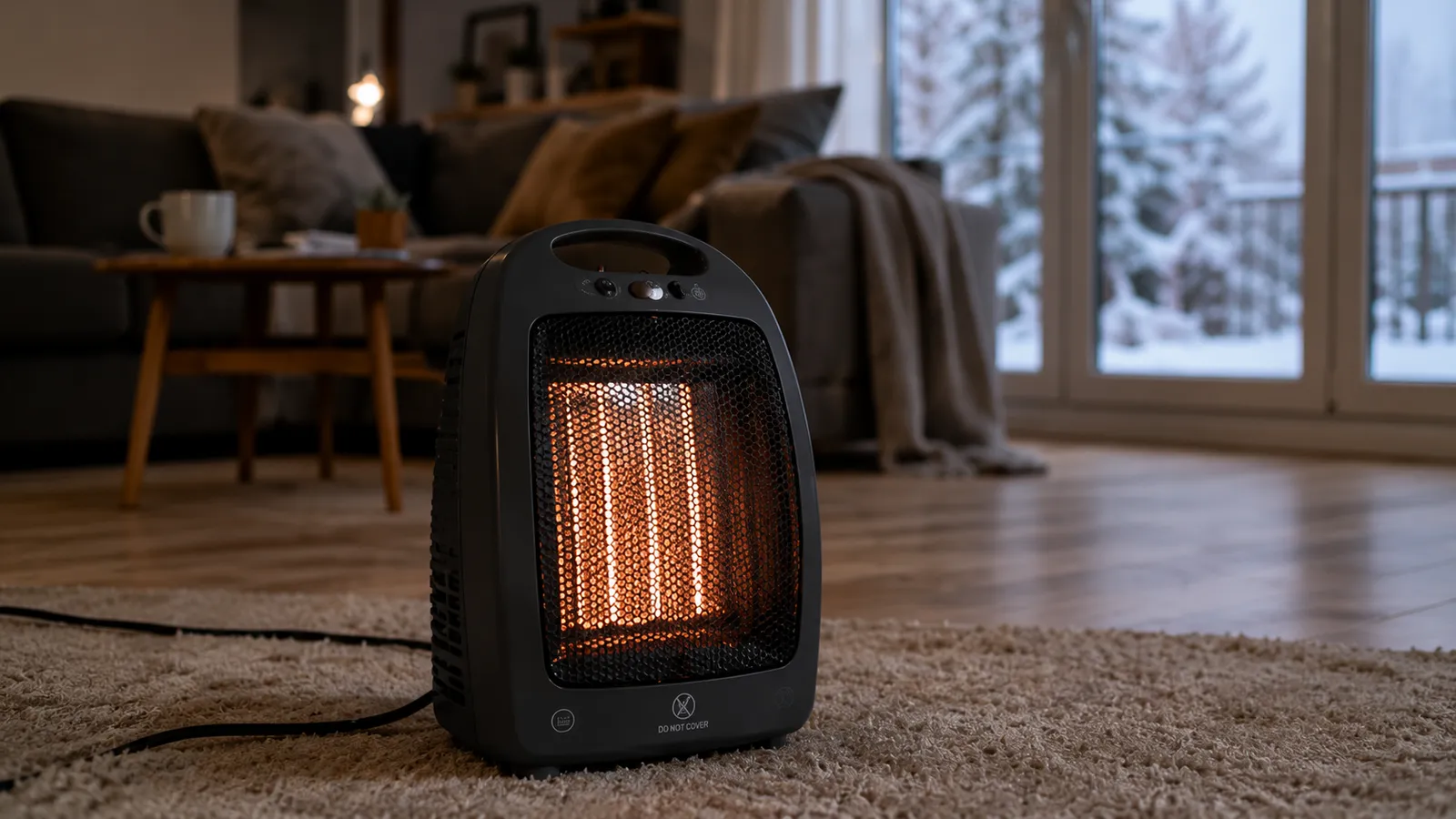
A plug-in electric heater is the cheapest heating appliance to buy and one of the most expensive to run. There is no clever specification to look for and no brand that quietly beats the others: the running cost is the heater's power in kilowatts, multiplied by the hours it actually draws power, multiplied by your price per kWh. At the United States average of $0.18/kWh, a typical 1,500 W model costs about $0.27 an hour, about $1.08 a day if it runs four hours, and roughly $130 across a 120-day heating season. Everything below is where those numbers come from, how they move with your tariff and your room, and which of them you can realistically change.
The whole calculation is three numbers
Every figure on this page comes from one line of arithmetic:
kilowatts × hours at full power × price per kWh = cost
Divide the wattage on the label by 1,000 to get kilowatts: a 1,500 W heater is 1.5 kW, a 2,000 W one is 2 kW. There is no efficiency term in that formula, and that is the important part. A space heater is a resistive appliance — a wire that gets hot — so essentially 100% of the electricity it draws leaves it as heat in the room. Nothing is lost up a flue and nothing is wasted, which sounds excellent until you notice the flip side: you can never get more heat out than the electricity you paid for. That is exactly one unit of heat per unit bought, and it is the worst ratio of any heating system in a normal home.
The space heater appliance page on this site uses 750 W as the low end (a small fan heater, or the low setting on a bigger one), 1,500 W as typical, and 3,000 W as the top of the range for a large oil-filled radiator on a 230 V supply. Those three numbers bracket almost everything sold.
What a space heater costs per hour
Cost per hour is the cleanest way to compare, because it strips out every assumption about how you use it. These are the residential averages this site uses in its calculators — see electricity prices by country for the full list and what moves them.
| Heater power | US · $0.18/kWh | UK · £0.24/kWh | Spain · €0.27/kWh | Germany · €0.39/kWh |
|---|---|---|---|---|
| 750 W (low setting, small fan heater) | $0.14 | £0.18 | €0.20 | €0.29 |
| 1,500 W (typical) | $0.27 | £0.36 | €0.41 | €0.59 |
| 2,000 W | $0.36 | £0.48 | €0.54 | €0.78 |
| 3,000 W (large oil-filled radiator) | $0.54 | £0.72 | €0.81 | €1.17 |
Two things stand out. First, the spread between countries is bigger than the spread between heaters: the same 1,500 W unit costs more than twice as much per hour in Germany as it does in the United States, without a single thing being different about the appliance. Second, an hour is cheap and a winter is not — which is the whole reason people are surprised by the bill rather than by the hourly rate.
Per day and per winter: where it stops being small change
A heater is a seasonal load, so a yearly average is misleading. The realistic frame is a heating season of roughly 120 days — about four months of genuinely cold weather — which is what the calculators on this site assume for seasonal appliances. Here is what four common patterns of use add up to.
| How it gets used | kWh per day | kWh over 120 days | US · $0.18 | UK · £0.24 | Spain · €0.27 |
|---|---|---|---|---|---|
| 750 W taking the chill off a bedroom, 2 h/day | 1.5 | 180 | $32.40 | £43.20 | €48.60 |
| 1,500 W in the living room, 4 h/day | 6 | 720 | $129.60 | £172.80 | €194.40 |
| Two 1,500 W heaters, 5 h/day | 15 | 1,800 | $324.00 | £432.00 | €486.00 |
| 2,000 W in a home office, 8 h/day | 16 | 1,920 | $345.60 | £460.80 | €518.40 |
The bottom two rows are the ones that catch people out. Working from home in a cold room, or putting a second heater in the bedroom because the first one is downstairs, moves a heater from a rounding error to one of the two or three largest single items on the bill. It also arrives as a step change: a bill that was steady all autumn jumps in a single billing period, which is the most common reason people go looking for a fault that is not there — see why an electricity bill suddenly jumps if that is what brought you here.
Why almost every US heater is 1,500 W and European ones are not
This trips up anyone comparing figures across countries. A standard North American socket runs at 120 V on a 15 A circuit, which caps out at 1,800 W — and safety rules derate a continuous load to 80% of that, about 1,440 W. So 1,500 W is not a design choice, it is the ceiling, and virtually every plug-in heater sold in the US sits at or just under it. A UK or European 230 V socket on a 13 A or 16 A fuse allows about 3,000 W, so 2,000 W and 3,000 W models are ordinary there.
The practical consequence: a European heater can pull twice the power of an American one, so it heats a cold room roughly twice as fast — and costs twice as much per hour while it does. Neither is more or less efficient. If you are reading a running-cost figure from a site in another country, check the wattage and the price per kWh before you assume it applies to you, because both usually differ.
No type of electric heater is cheaper to run than another
Fan heaters, ceramic heaters, oil-filled radiators, halogen bars, "infrared" panels and micathermic panels are all the same thing electrically: a resistance element. At the same wattage, for the same hours, they cost exactly the same. A 2,000 W oil-filled radiator and a 2,000 W fan heater running for an hour both consume 2 kWh. Any claim that one type is a "low-energy" or "energy-saving" heater is describing comfort, not consumption.
Three things do genuinely differ, and they are worth understanding because they change how long you leave it on:
- How fast you feel warm. A fan heater blows hot air at you immediately; an oil-filled radiator takes 15–20 minutes to warm its oil and then radiates gently. If a fan heater gets you comfortable in five minutes and you switch it off, it wins on cost — not because it is efficient, but because it bought you fewer hours.
- How the heat is kept. An oil-filled radiator keeps giving out heat after you unplug it, because the oil is still hot. That is not free energy, it is energy you already paid for being released later, but it does mean you can switch off earlier.
- The quality of the controls. This is the one that actually matters, and it is covered next.
The thermostat is the dial that changes your bill
The formula asks for hours at full power, not hours switched on, and that distinction is where most estimates go wrong. A heater with a working thermostat brings the room up to temperature at full power, then cycles — on for a couple of minutes, off for several — to hold it there. The fraction of time it is actually drawing power is its duty cycle, and it decides the real cost.
In a small, draught-proofed room with the door shut, a 2,000 W heater may spend only 40–60% of the time drawing power once the room is warm, so four hours on the clock costs about the same as two hours of continuous running. In a draughty room, a room with a large cold window, or a room with the door open to a cold hallway, the duty cycle climbs towards 100% and the heater simply never catches up. That is the same appliance costing twice as much for identical comfort, and the difference is the room, not the heater.
One related myth worth killing: in a thermostat-controlled room, running a heater on its low setting does not save money. The room needs a fixed amount of heat to hold its temperature against the cold outside; on the low setting the heater simply runs for longer to deliver it. Low settings are useful for comfort and for avoiding overshoot in a small room, not for cost. What genuinely saves is a timer that stops the heater running while you are asleep or out, and a thermostat set at the lowest temperature you find comfortable rather than the highest one the dial offers.
What the alternatives cost for the same heat
Because a resistive heater delivers exactly one unit of heat per unit of electricity, it is easy to compare it fairly with anything else: work out what each option costs to deliver one kWh of heat into the room.
| Way of heating | Electricity used per kWh of heat | Cost per kWh of heat at $0.18 |
|---|---|---|
| Plug-in electric heater (any type) | 1.00 kWh | $0.18 |
| Air-source heat pump, seasonal COP 3.0 | 0.33 kWh | $0.06 |
| Air-source heat pump in cold weather, COP 2.0 | 0.50 kWh | $0.09 |
| Heat pump running on its resistance backup | 1.00 kWh | $0.18 |
A heat pump does not make heat, it moves it, which is why it can deliver three units for one. The same 720 kWh of heat that costs $130 from a plug-in heater costs about $43 from a heat pump running at a seasonal COP of 3. That gap is the reason the honest advice about space heaters is narrow: they are fine for occasional, short, one-room top-up warmth, and a poor answer for heating the same rooms every day all winter. If that second case is yours, the heat pump versus gas boiler running cost guide and the heat pump comparison calculator are the right places to look.
The other alternative is not to heat the room at all. An electric blanket draws about 100 W and warms you directly instead of warming several cubic metres of air. Two hours a night across the same 120-day season uses roughly 24 kWh, about $4.32 at $0.18/kWh — the cost of four evenings with the 1,500 W heater. It does a different job, but for sitting still on a sofa or getting into a cold bed it does that job for a thirtieth of the money.
Seven changes that actually move the number
- Shut the door. A closed door is the single largest free saving, because it decides how much air you are heating. Heating one room with the door open to a cold hallway is heating the hallway.
- Set the thermostat once, low, and leave it. Turning the dial to maximum does not warm the room faster — the heater already runs at full power until the set point. It only makes the room overshoot and cost more.
- Use the timer. A heater running in an empty room, or through the hours you are asleep under a duvet, is the purest waste on this list and the easiest to remove.
- Draught-proof the obvious gaps. Under-door strips, window seals and a curtain drawn at dusk cut the duty cycle, which cuts the hours at full power, which is the term you are paying for.
- Heat the person before the room. A blanket, a throw and a jumper let you hold the room a couple of degrees lower, and every degree of set point is real money over 120 days.
- Never buy on the "energy-saving" claim. Buy on the controls: a real thermostat, a usable timer, and a wattage matched to the room rather than the biggest one on the shelf.
- Check when you run it. On a time-of-use tariff, evening hours are usually the most expensive block of the day, which is exactly when a heater is on — see the guide to time-of-use tariffs before assuming your rate is flat.
Work out your own figure
The tables above use average national prices, and averages are only a starting point. Take the wattage from your heater's label or rating plate, the price per kWh from your own bill, and an honest estimate of the hours, and run it through the electricity cost calculator — it takes watts, hours and your rate and gives the cost per day, month and year. If you want to see how the heater sits against everything else in the house rather than on its own, add it to the whole-home estimator, which totals a full appliance list and shows what share each one takes.
Frequently asked questions
How much does a space heater cost to run per hour?
Multiply the heater kilowatts by your price per kWh. A 1,500 W heater is 1.5 kW, so at the US average of $0.18/kWh it costs about $0.27 an hour, and a 2,000 W model about $0.36. Nothing else in the specification changes that figure.
Which type of electric heater is cheapest to run?
None of them. Fan, ceramic, halogen and oil-filled heaters all turn essentially all the electricity into heat, so at the same wattage they cost the same per hour. They differ in how fast a room feels warm and how evenly the heat spreads, not in running cost.
Is a space heater cheaper than central heating?
Only if it lets you heat one occupied room instead of the whole house, and only for a few hours. Per unit of heat delivered, electric resistance heating is the most expensive option most homes have, so heating several rooms this way usually costs more than the central heating would.
Do energy-saving space heaters really save money?
Not through efficiency, because every electric heater is already close to 100% efficient at making heat. What genuinely saves money is an accurate thermostat and a timer, since both cut the hours the element actually draws power. Judge a heater by its controls, not by the claim on the box.